For cancer survivors who have undergone life-saving radiation therapy for head and neck malignancies, defeating the initial disease is a monumental milestone. However, the legacy of radiation can sometimes surface months, years, or even decades later as a hidden, progressive complication within the skeletal structure of the face: Osteoradionecrosis of the Jaw (ORNJ).
Characterized by exposed, non-healing bone that fails to heal over a period of three months or more, ORNJ is a painful and functionally debilitating condition. Standard wound care and traditional antibiotics often fail to resolve it because the underlying issue is not a simple localized infection. Rather, it is a profound architectural crisis within the tissue caused by a lack of oxygen, blood supply, and cellular vitality.
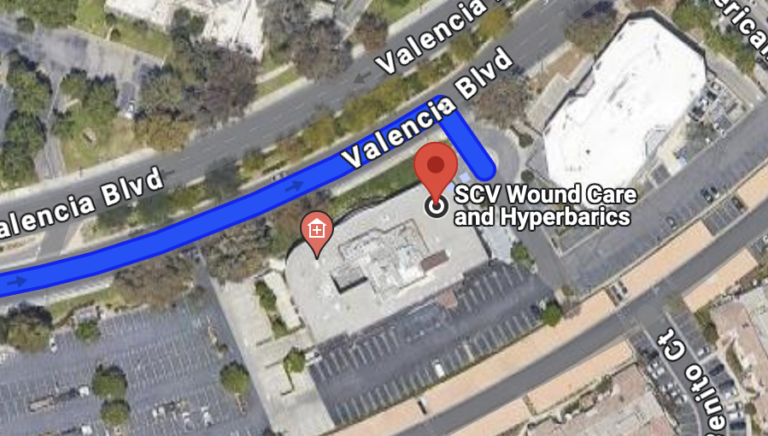
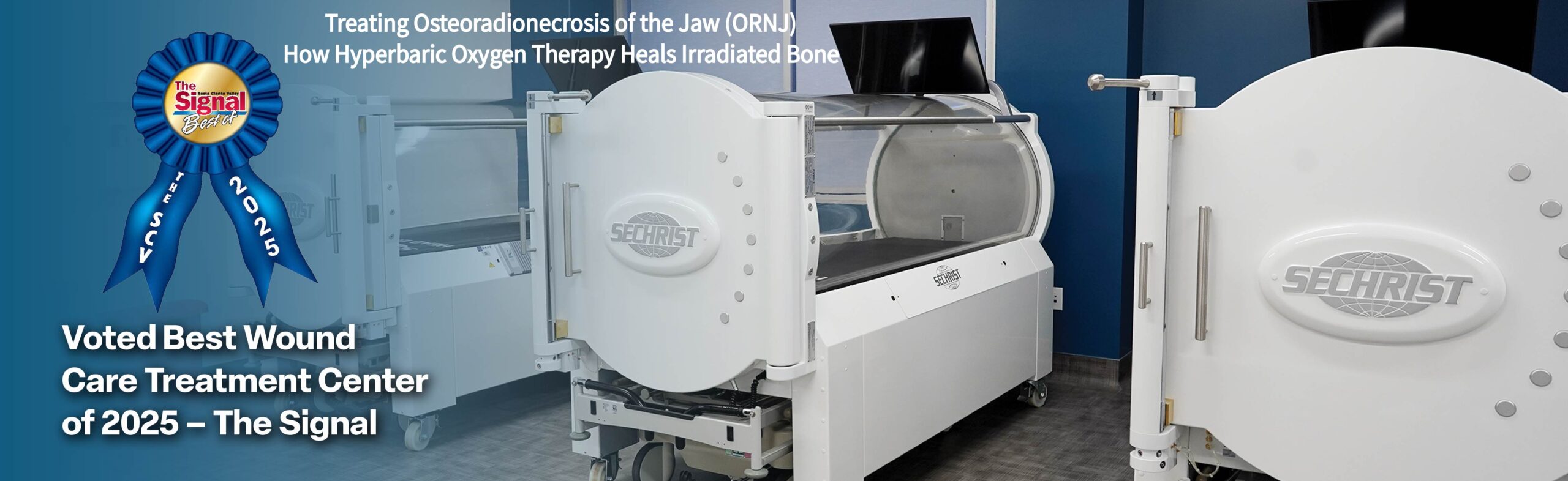
At SCV Wound Care and Hyperbarics, located at 23838 Valencia Blvd, Suite 100, we provide advanced, physician-led clinical solutions to address this severe bone complication right here in the Santa Clarita Valley. Utilizing hospital-grade Sechrist monoplace hyperbaric chambers, we deliver targeted Hyperbaric Oxygen Therapy (HBOT) to reverse the deep-tissue damage caused by radiation, restore local vascularity, and stimulate definitive bone healing.
Understanding the Root Cause: Why Radiation Destroys Jaw Bone Tissue
To understand why ORNJ develops, it is essential to understand how radiation interacts with living tissue. While high-energy radiation beams are highly effective at destroying malignant tumor cells, they inevitably cause collateral damage to the surrounding healthy structures, including the mandible (lower jaw) and maxilla (upper jaw).
Radiation initiates a progressive, microscopic process within the tissue that leading oral and maxillofacial surgeons describe as the 3H triad:
-
Hypocellularity: A severe depletion of the vital cells (such as osteoblasts and fibroblasts) responsible for remodeling bone and maintaining the soft tissue lining of the mouth.
-
Hypovascularity: The gradual scarring, narrowing, and destruction of the tiny capillaries and blood vessels that supply oxygen and essential nutrients to the jawbone.
-
Hypoxia: A state of chronic, profound oxygen starvation within the deep tissues.
Because the mandible is naturally a dense, highly compact bone with a limited, terminal blood supply compared to other bones in the body, it is uniquely vulnerable to this radiation-induced devastation. Over time, the tissue becomes fibrotic, scarred, and incapable of normal cellular turnover.
If the patient undergoes a subsequent invasive dental procedure—such as a tooth extraction, dental implant placement, or deep root planing—or if they experience minor trauma from a ill-fitting denture, the compromised bone cannot mount a normal healing response. The tissue breaks down, the overlying mucous membrane recedes, and dead, exposed bone is left vulnerable to the oral environment. In severe cases, ORNJ can even develop spontaneously without any preceding dental trauma.
The Clinical Framework: The Marx Protocol for ORNJ
When managing established osteoradionecrosis of the jaw, clinical success requires a structured, evidence-based approach rather than sporadic treatments. At SCV Wound Care and Hyperbarics, our clinical management is anchored in the internationally recognized Marx Protocol.
Developed by Dr. Robert E. Marx, an eminent authority in oral and maxillofacial surgery, this protocol establishes a systematic, multi-tiered approach that combines hyperbaric oxygen therapy with strategic surgical debridement or resection based on the severity of the bone necrosis.
The Marx Protocol categorizes ORNJ into three distinct clinical stages:
Stage I
This stage applies to patients with exposed bone who do not have pathological fractures, systemic infection, or skin fistulas. The protocol initiates with an initial course of 30 consecutive daily HBOT sessions (dives). Following this initial block, the patient is re-examined. If the exposed bone shows signs of softening, structural stabilization, or spontaneous detachment of dead fragments (sequestra) along with healthy granulation tissue coverage, the patient receives an additional 10 to 20 post-treatment dives to complete definitive healing without requiring aggressive surgery.
Stage II
If a patient undergoes the initial 30 HBOT sessions but demonstrates no clinical improvement or flattening of the exposed bone margins, they advance to Stage II. At this point, a conservative surgical debridement is performed to remove the superficial, non-viable bone fragments. Crucially, this surgery is not performed on hypoxic tissue; instead, it is performed after the initial 30 dives have already established a newly vascularized tissue bed. Following the minor surgical refinement, the patient receives 20 subsequent post-operative HBOT dives to seal the surgical margins and secure mucosal closure.
Stage III
This stage is reserved for advanced cases where the patient presents from the outset with a pathological fracture of the jaw, a cutaneous fistula (an abnormal opening through the skin of the face or neck), or extensive bone destruction extending to the inferior border of the mandible. Stage III requires an aggressive surgical approach to reconstruct the jaw using bone grafts or reconstruction plates. However, to ensure the surgical graft survives in a previously irradiated field, the patient must first undergo 30 preoperative HBOT dives to prepare the biological ground, followed by 20 postoperative dives to support the new graft and soft tissue flaps.
By adhering to this rigorous, staged framework, in collaboration with your surgeon, we eliminate the guesswork and ensure that surgical interventions are executed when the surrounding tissue is biologically capable of healing.
How Hyperbaric Oxygen Therapy Heals Bone from the Inside Out
The underlying mechanism of HBOT in treating ORNJ centers entirely on reversing the chronic hypoxia caused by radiation. During a hyperbaric session at our Valencia clinic, patients breathe 100% pure oxygen while inside a treatment chamber pressurized to greater than sea-level atmospheric pressure (typically between 2.0 atmospheres absolute, or ATA).
This elevated pressure physics engine forces massive amounts of oxygen to dissolve directly into the blood plasma, independent of hemoglobin binding. This hyper-oxygenated plasma travels throughout the body, reaching deep into the scarred, ischemic tissues of the jaw where damaged blood vessels can no longer effectively transport red blood cells.
This cyclical influx of high-pressure oxygen triggers several critical physiological healing cascades:
-
Angiogenesis (Neovascularization): The rapid alternation between hyperoxia (during the dive) and baseline oxygen levels creates a powerful biochemical signaling environment. This stimulates the expression of Vascular Endothelial Growth Factor (VEGF), which recruits endothelial cells to sprout brand-new, healthy capillary networks into the irradiated bone and soft tissues.
-
Osteogenesis and Bone Remodeling: Oxygen is the primary fuel required by osteoblasts (bone-building cells) to synthesize collagen and lay down the essential matrix needed for bone repair and structural stability.
-
Enhanced Antimicrobial Activity: While ORNJ is fundamentally an ischemic disease rather than a primary infection, exposed dead bone quickly becomes colonized by oral bacteria. Hyperbaric oxygen generates oxygen free radicals that directly kill anaerobic bacteria and significantly boost the ability of white blood cells (neutrophils) to destroy pathogens.
The Peer-Reviewed Evidence: What the Science Says
The integration of Hyperbaric Oxygen Therapy into head and neck radiation recovery protocols is backed by decades of rigorous, peer-reviewed clinical research.
-
Reversing Tissue Hypoxia: A foundational study tracing radiation-induced tissue injury demonstrates that hyperbaric oxygen therapy acts as a direct stimulus for neo-angiogenesis. The cycling of high-pressure oxygen triggers cellular and cytokine responses, inducing a dramatic, measurable regrowth of healthy capillary networks in damaged tissues. You can read the full text regarding the historical paradigm shift and physiological mechanics of radiation tissue repair in this detailed review on the National Institutes of Health PMC Free Journal Archive.
-
The Landmark Marx Data: The staging system and clinical management frameworks used worldwide today stem directly from Dr. Robert E. Marx’s pioneering clinical trials. His data confirms that combining targeted surgical debridement with pre- and post-operative HBOT blocks yields a predictable, definitive cure rate of over 95% for advanced mandibular bone death. To review the original clinical outcomes and staging definitions, you can access the study abstract directly via the National Center for Biotechnology Information (NCBI) / NIH PubMed repository.
Accessible, World-Class Wound Care for the Santa Clarita Valley
For patients dealing with the complex, painful realities of osteoradionecrosis of the jaw, traveling long distances over multiple weeks for daily specialty medical care adds an unnecessary burden to an already challenging recovery journey.
SCV Wound Care and Hyperbarics eliminates that commute. Our state-of-the-art facility brings advanced hyperbaric medicine directly to your neighborhood. We serve patients across the entirety of the Santa Clarita Valley and its surrounding communities, providing local care to residents in:
-
Valencia
-
Stevenson Ranch
-
Saugus
-
Newhall
-
Canyon Country
-
Castaic
-
Acton
Our clinical team collaborates seamlessly with your treating oral surgeon, urologist, oncologist, or primary care provider to coordinate your Marx Protocol seamlessly, managing everything from insurance authorizations to detailed physical monitoring across your entire treatment block.
Reclaim Your Health and Comfort
Osteoradionecrosis of the jaw is a progressive condition, but it is entirely treatable when caught early and managed with an appropriate, evidence-based physiological approach. If you are a past head and neck cancer patient experiencing tooth pain, localized swelling, jaw stiffness, or visible areas of exposed bone following radiation therapy, do not wait for the symptoms to advance.
Contact our specialist team today to schedule an evaluation. Let us help you harness the power of advanced hyperbaric oxygen therapy to repair deep tissue damage, stop bone degradation, and support your body’s natural capacity to heal.
SCV Wound Care and Hyperbarics
23838 Valencia Blvd, Suite 100, Valencia, CA
Learn more about our clinical protocols and view our facility artwork at scvwoundcare.com.