For patients with limited mobility, bed rest requirements, or neurological impairments, a localized area of red, tender skin over a bony prominence can rapidly escalate into a serious medical complication: a pressure ulcer (commonly referred to as a bed sore or pressure injury).
Pressure ulcers are far more than superficial skin irritation. They represent a complex ischemia-reperfusion injury affecting the skin, subcutaneous fat, muscle, and potentially underlying bone. Left unmanaged, a localized pressure ulcer can lead to severe systemic infection, osteomyelitis, extended hospitalizations, and a significant loss of independence.
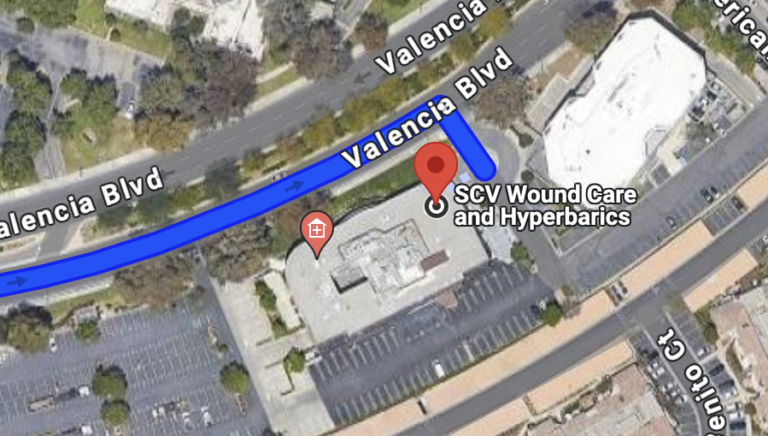
At SCV Wound Care and Hyperbarics, located at 23838 Valencia Blvd, Suite 100, our physician-led team provides advanced clinical protocols designed to arrest tissue degradation and accelerate healing right here in the Santa Clarita Valley. By combining comprehensive anatomical staging, precise microclimate management, specialized pressure offloading, and advanced cellular therapies, we convert compromised, ischemic tissue back into a healthy, healing wound bed.
The Biomechanics of Pressure Ulcers: Extrinsic and Intrinsic Factors
To understand why pressure ulcers form and persist, it is essential to examine the physiological forces acting on soft tissue sandwiched between an internal bony prominence (such as the sacrum, heels, ischium, or trochanters) and an external surface (like a mattress or wheelchair cushion).
When external pressure exceeds capillary closing pressure (typically 32 mmHg in normal microvascular beds), local blood vessels collapse. This cuts off oxygen and essential nutrients to the surrounding tissue, initiating a rapid cellular cascade:
Ischemic Cell Death: Deprived of arterial blood flow, cells experience metabolic failure within hours, accumulating toxic metabolic waste products.
Reperfusion Injury: When pressure is temporarily relieved and blood flow returns, the sudden influx of oxygen generates free radicals and pro-inflammatory cytokines, causing secondary microvascular damage.
Shear and Friction: Mechanical shear occurs when the skin remains stationary against a surface while underlying deep tissue and bone slide (such as when a bed head is elevated above 30 degrees). Shear stresses stretch and tear delicate blood vessels in the deep subcutaneous tissue and muscle layers.
Microclimate Degradation: The localized temperature and moisture environment surrounding the skin play a critical role. Excessive skin moisture (from perspiration, wound exudate, or incontinence) causes maceration, weakening the stratum corneum and making the epidermis exponentially more susceptible to shear forces.
Clinical Staging of Pressure Ulcers
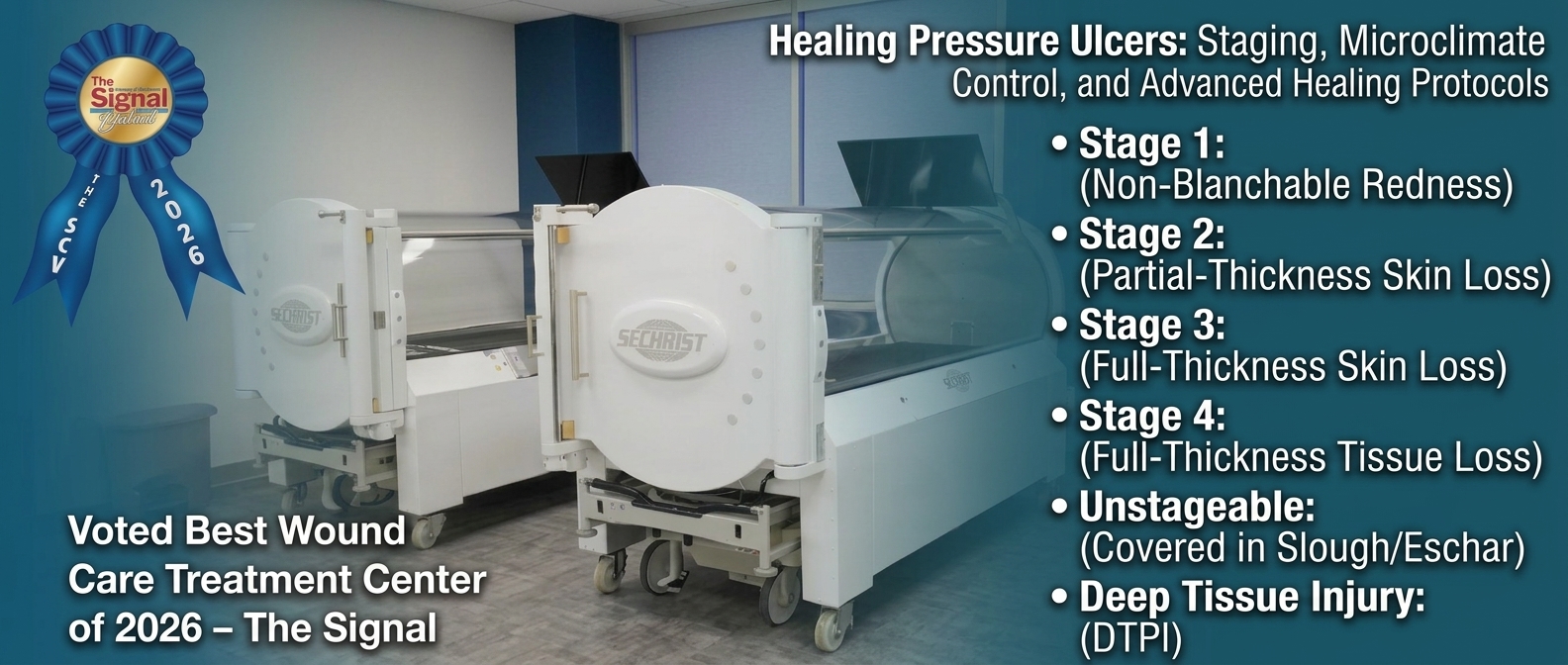
Accurate clinical staging established by the National Pressure Injury Advisory Panel (NPIAP) is the foundation of targeted wound care. Staging defines the maximum depth of tissue damage:
Stage 1: Non-Blanchable Erythema
Intact skin with a localized area of non-blanchable redness (discoloration that does not turn white when pressed). In darker skin tones, this may present as persistent purple/blue discoloration, localized warmth, or changes in tissue firmness.
Stage 2: Partial-Thickness Skin Loss
Partial-thickness loss of dermis presenting as a shallow open ulcer with a red-pink wound bed, without slough or bruising. May also present as an intact or ruptured serum-filled blister.
Stage 3: Full-Thickness Skin Loss
Full-thickness tissue loss where subcutaneous fat may be visible, but bone, tendon, or muscle are not exposed. Slough or eschar may be present, along with undermining and tunneling.
Stage 4: Full-Thickness Tissue Loss
Full-thickness skin and tissue loss with exposed bone, tendon, cartilage, or muscle. Slough and eschar are frequently present, and osteomyelitis (bone infection) is a major risk factor requiring systemic medical management.
Unstageable Pressure Ulcer
Full-thickness tissue loss in which the base of the ulcer is completely covered by slough (yellow, tan, gray, green, or brown) or eschar (tan, brown, or black) in the wound bed. The true depth cannot be confirmed until enough slough/eschar is removed.
Deep Tissue Pressure Injury (DTPI)
Intact or non-intact skin with localized, persistent non-blanchable dark discoloration (deep red, maroon, purple) or epidermal separation revealing a dark wound bed or blood-filled blister, resulting from intense or prolonged pressure and shear at the bone-muscle interface.
Advanced Multimodal Healing Protocols
At SCV Wound Care and Hyperbarics, we implement a comprehensive, evidence-based strategy to halt tissue breakdown and promote rapid tissue regeneration:
1. Pressure Offloading & Support Surfaces
No topical treatment or advanced dressing can heal a pressure ulcer if mechanical pressure remains unmitigated. We work directly with patients, families, and home health providers to implement:
Dynamic Support Surfaces: Prescribing alternating pressure air mattresses, low air loss mattresses, or high-specification foam overlays to redistribute interface pressure.
Anatomical Offloading: Implementing strict heel-suspension devices (floating heels), custom seating cushions (Roho/contoured foam), and structured 30-degree lateral tilting schedules.
2. Microclimate Control & Advanced Dressings
Controlling interface temperature and humidity preserves stratum corneum integrity and prevents maceration. Our clinical team utilizes:
Breathable Multi-Layer Foam Dressings: Silicone-bordered sacral and heel foam dressings that absorb excess exudate, reduce shear friction, and maintain a balanced moisture environment.
Gelling Fiber & Alginate Dressings: For moderate-to-heavy exudate, specialized sodium carboxymethylcellulose (CMC) or alginate dressings trap fluid and bacterial bioburden within a cohesive gel matrix.
3. Serial Debridement & Biofilm Management
In Stage 3, Stage 4, and Unstageable pressure ulcers, devitalized slough and eschar harbor destructive bacterial biofilms. To clear non-viable bioburden and expose a clean, vascularized wound bed, our physicians perform weekly targeted debridement. Read our comprehensive guide on accelerating healing with weekly debridement to learn how serial removal of devitalized tissue resets chronic inflammation.
4. Advanced Modalities (NPWT, CTPs, & HBOT)
When a deep pressure ulcer stalls despite standard care, we deploy advanced tissue-reconstruction modalities:
Negative Pressure Wound Therapy (NPWT): Controlled sub-atmospheric pressure (“wound vac”) removes exudate, draws wound margins together, and stimulates localized angiogenesis and granulation tissue formation.
Cellular and Tissue-Based Products (CTPs): Application of bioengineered placental or dermal allografts to supply extracellular matrix scaffolding and bioactive growth factors.
Hyperbaric Oxygen Therapy (HBOT): For deep Stage 4 ulcers with exposed bone and chronic refractory osteomyelitis, adjunctive hyperbaric oxygen increases plasma-dissolved oxygen concentration up to 20-fold, stimulating collagen synthesis, enhancing neutrophil bacterial killing, and promoting stem cell mobilization.
The Peer-Reviewed Science: Evidence-Based Clinical Proof
The protocols implemented at SCV Wound Care and Hyperbarics reflect international, peer-reviewed clinical guidelines and multi-center registry research:
Pressure Injury Clinical Guidelines & Prevention: International consensus guidelines on wound management emphasize structured risk assessment (Braden Scale), anatomical offloading, microclimate management, and specialized wound bed preparation as essential pillars for pressure ulcer resolution.
- Hyperbaric Oxygen for Chronic Refractory Osteomyelitis: Peer-reviewed clinical literature demonstrates that adjunctive hyperbaric oxygen therapy significantly enhances neutrophil-mediated bacterial clearance and bone repair in deep, non-healing wounds complicated by osteomyelitis.
Microclimate & Shear Reduction: Biomechanical research confirms that controlling moisture and skin temperature directly lowers the coefficient of friction and mechanical shear, reducing deep tissue strain over bony prominences.
Role of Debridement and Frequency: Retrospective multi-center cohort studies evaluating hundreds of thousands of chronic wounds confirm that weekly evaluation and serial debridement of necrotic burden significantly shorten median healing times and increase overall closure rates.
What to Expect During Your Evaluation in Valencia
Managing a complex pressure ulcer requires continuous, specialist medical oversight. Your initial consultation at SCV Wound Care and Hyperbarics includes:
Comprehensive Anatomical Staging & Assessment: Precise measurement of length, width, depth, undermining, and tissue characteristics, alongside photo-documentation to track weekly surface area reduction.
Vascular & Systemic Screening: Evaluation of arterial perfusion (ABI/transcutaneous oxygen monitoring) and nutritional baseline (albumin/prealbumin) to ensure the tissue has adequate systemic building blocks for repair.
Personalized Offloading & Dressing Prescription: Custom selection of advanced dressings, offloading footwear or support surface referrals, and a coordinated home health treatment plan.
Dedicated Specialty Wound Care for the Santa Clarita Valley
Managing a severe pressure ulcer or supporting an immobilized family member is physically and emotionally demanding. Driving over the Newhall Pass into central Los Angeles or managing busy hospital emergency departments for weekly wound changes adds unnecessary friction and physical discomfort.
SCV Wound Care and Hyperbarics brings hospital-grade, physician-led specialty care directly to your local community. Located conveniently on Valencia Blvd, our clinic serves patients throughout the entire Santa Clarita Valley, including:
Valencia
Stevenson Ranch
Saugus
Newhall
Canyon Country
Castaic
Acton
Our clinical team coordinates directly with your primary care physician, neurologist, orthopedic surgeon, or home health care team to maintain a unified, supportive care continuum.
Dedicated Local Care & Community Recognition
SCV Wound Care and Hyperbarics is committed to bringing evidence-based clinical excellence and accessible specialty medicine directly to Santa Clarita residents.
Explore Our Clinical Services: Visit our SCV Wound Care homepage to learn more about our comprehensive treatment modalities, hyperbaric chambers, and clinic location in Valencia.
In the Media: Watch our clinic feature on The Daily Buzz to learn more about our patient-centered philosophy and specialized medical capabilities.
Restart Your Healing Journey Today
A pressure ulcer is a progressive medical condition, but it responds dramatically to specialized, evidence-based wound care. If you, a loved one, or a patient you care for is living with a non-healing pressure sore, broken skin over a bony prominence, or a deep tissue ulcer, do not wait for complications to escalate.
Contact our specialist medical team today to schedule a comprehensive wound evaluation.
SCV Wound Care and Hyperbarics
23838 Valencia Blvd, Suite 100, Valencia, CA
Explore our complete range of advanced wound care modalities at scvwoundcare.com.